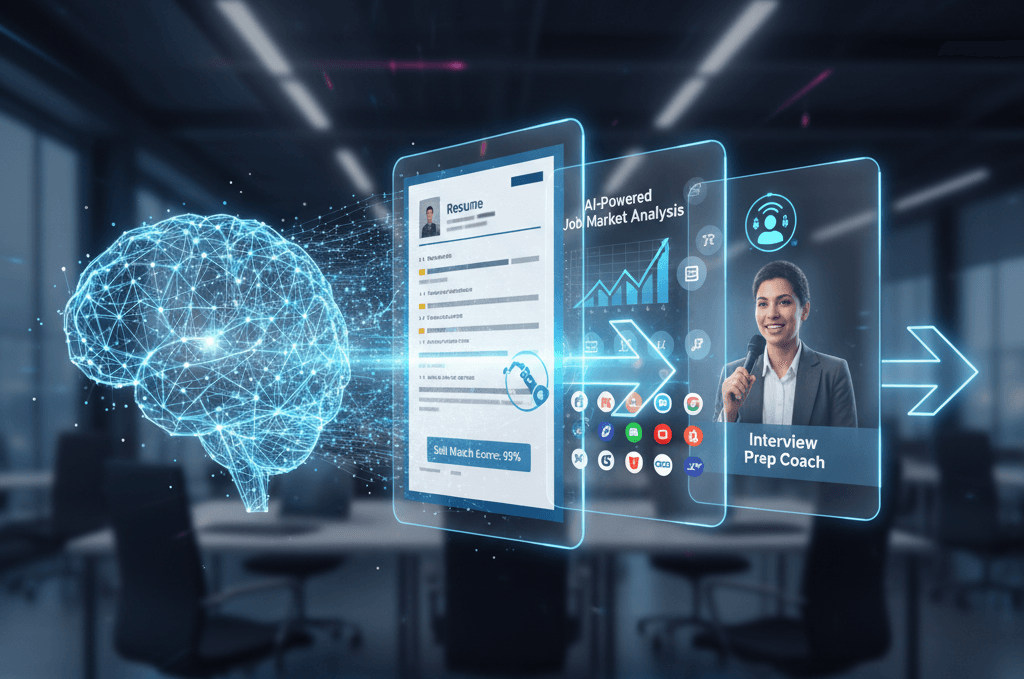
The job search landscape has undergone a significant transformation, with artificial intelligence emerging as a powerful ally for job seekers. Understanding what are the best AI tools and how to deploy them strategically is no longer optional; it's a critical skill for mid-level professionals looking to gain a competitive edge. These tools offer unprecedented efficiency, personalization, and insight, streamlining tasks from crafting compelling applications to mastering interviews and expanding professional networks.
The AI Job Search Toolkit: An Overview
The modern job search is enhanced by AI tools that streamline tasks from resume writing to interview prep. These tools leverage machine learning to analyze job descriptions, generate tailored content, and provide personalized feedback, significantly boosting efficiency and effectiveness for job seekers across various stages of their career journey.
AI's role in the job search extends far beyond simple resume and cover letter generation. For mid-level professionals, AI offers a strategic advantage by automating repetitive tasks, providing data-driven insights, and personalizing communications at scale. This allows you to focus on high-value activities like networking and skill development, rather than getting bogged down in administrative details.
The landscape of AI tools for job seekers can be broadly categorized. These include tools for application generation, interview preparation, networking and LinkedIn optimization, career exploration, skill development, and general productivity. Each category offers unique benefits designed to enhance a specific aspect of your job hunt.
AI Tools for Crafting Standout Applications (Resumes & Cover Letters)
AI tools revolutionize resume and cover letter creation by analyzing job descriptions, optimizing for ATS, and generating personalized content. They help job seekers highlight relevant skills and experiences, ensuring their applications are tailored and professional, increasing their chances of getting noticed by recruiters.
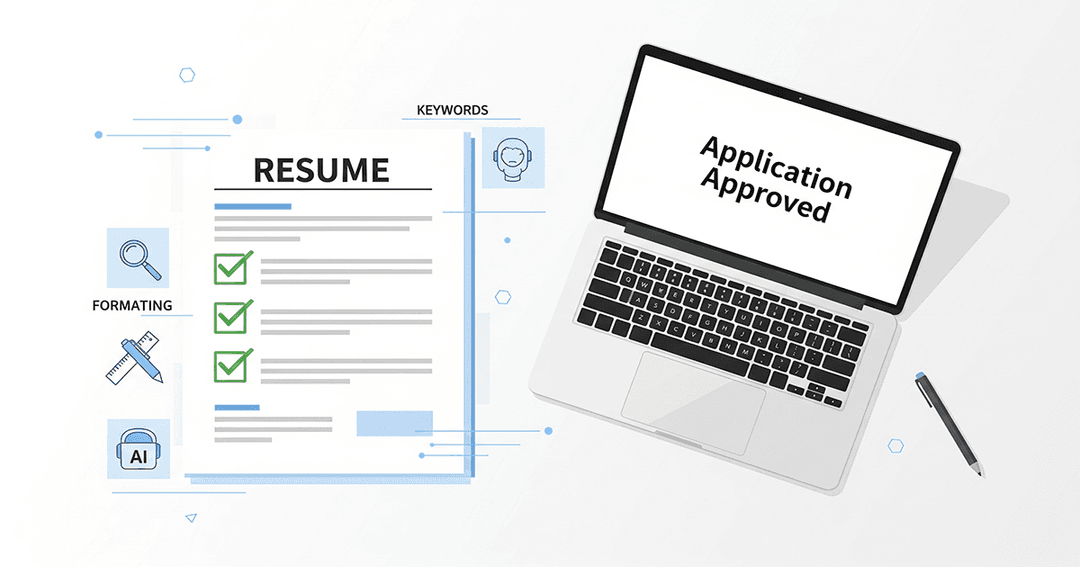
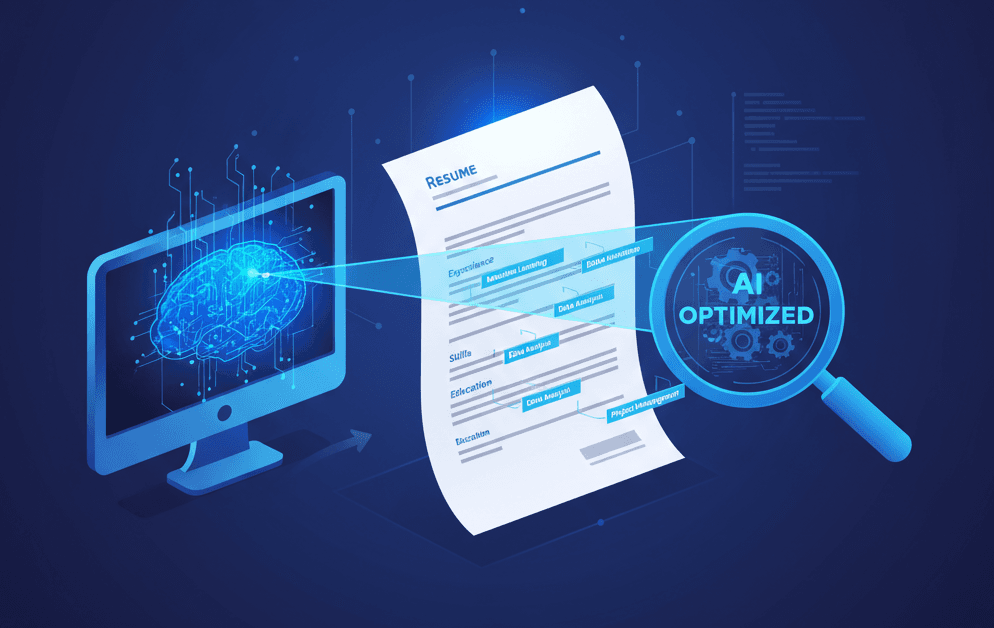
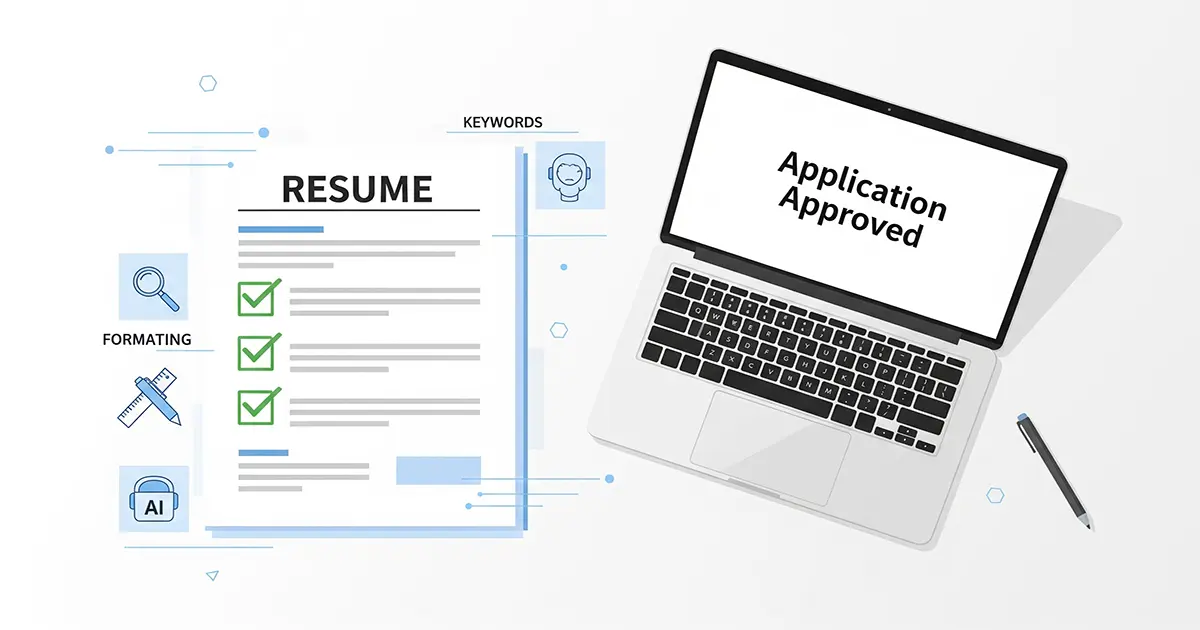
Over 75% of resumes are rejected by ATS before reaching a human recruiter, highlighting the critical need for optimization. AI-powered resume builders analyze job descriptions to identify keywords and phrases, then suggest how to integrate them into your resume naturally. This ensures your application makes it past the initial screening phase.
For example, if a job description frequently uses terms like "cross-functional team leadership" or "agile project management," an AI tool will flag these and prompt you to incorporate them, often suggesting specific phrasing based on your existing experience. This targeted approach is far more effective than generic applications; Jobscan reports that job seekers who tailor their resumes are three times more likely to get an interview.
Tool Name | Primary Function |
|---|
When using an AI cover letter generator, the goal is to produce a document that sounds authentically you. Start by feeding the AI your resume and the specific job description. Then, provide additional context: why you're interested in this particular company, a specific achievement that aligns with their needs, or a unique skill you bring. This personalization prevents the output from sounding generic or robotic.
After the AI generates a draft, review it meticulously. Look for overused phrases, awkward sentence structures, or any information that doesn't quite fit your experience. Refine the language to match your natural speaking style and ensure it highlights your unique value proposition. Recruiters are skilled at spotting generic content; your human touch makes the difference.
✅ Best Practice: Always fact-check AI-generated content against your actual experience. AI can hallucinate or misinterpret information, leading to inaccuracies that could undermine your credibility in an interview.
For AI-powered resume builder tools, focus on their ability to analyze job descriptions and provide targeted suggestions for keyword integration. Many platforms offer an ATS score, which indicates how well your resume matches the job posting. This feedback is invaluable for fine-tuning your resume to maximize its visibility.
Ethical AI Use in Applications
Using AI in your job applications is ethical as long as you maintain full ownership and accuracy of the content. AI should be treated as an assistant, not a replacement for your critical thinking or personal voice. Misrepresenting your skills or experience, even if generated by AI, remains unethical. The key is transparency and ensuring the final product genuinely reflects your qualifications.
Mastering the Interview: AI Tools for Preparation and Practice
AI tools for interview preparation offer realistic simulations, personalized feedback on verbal and non-verbal cues, and tailored practice questions. They help job seekers refine their answers, improve confidence, and identify areas for improvement, ensuring they are well-prepared to impress hiring managers.

Interviewing is a performance, and AI provides a private, unbiased stage for practice. Tools like Pramp, Interview Warmup by Google, and Big Interview utilize AI to simulate interview scenarios. They ask common behavioral questions (Tell me about a time you failed...) and role-specific technical questions, recording your responses for later review.
These platforms go beyond simple recording. They provide real-time feedback on critical elements such as your speaking pace, the number of filler words used (um, like
🧠 Expert Insight: Hiring managers often evaluate candidates not just on what they say, but how they say it. AI interview tools offer a safe space to refine your delivery, ensuring your message is clear, confident, and engaging.
To effectively use these interview preparation resources, begin by practicing general questions, then move to questions tailored to the specific job description. Use the AI's feedback to refine your STAR method responses for behavioral questions, ensuring you clearly articulate the Situation, Task, Action, and Result of your experiences. Focus on conciseness and impact.
Upload the job description: Many AI interview tools can ingest the job description to generate relevant questions, making your practice highly targeted.
Record your practice sessions: Don't just answer; record yourself. Reviewing your own performance is often the most effective way to identify habits you need to break or strengths you can leverage.
Analyze AI feedback: Pay attention to metrics like speaking pace and filler word count. Work on consciously reducing these during subsequent practice runs.
Refine your content: Use the AI's suggestions to strengthen your answers, ensuring they are concise, impactful, and directly address the interviewer's implicit questions.
Practice under pressure: Some tools offer timed responses, simulating the pressure of a real interview. This builds resilience and helps you think on your feet.
🎯 Key Takeaways
AI tools can significantly streamline and enhance every stage of your job search, from application to negotiation.
Personalization and human oversight are crucial to avoid generic AI-generated content and ensure authenticity.
Leverage AI for ATS optimization, keyword integration, and tailoring applications to specific job descriptions.
Utilize AI interview simulators to practice responses, refine delivery, and gain confidence.
AI can assist with LinkedIn optimization, networking outreach, career exploration, and skill development.
Building a strategic 'AI stack' maximizes efficiency, but always prioritize ethical use and data privacy.
Frequently Asked Questions
What is the best AI cover letter generator?
The 'best' AI cover letter generator often depends on your specific needs. Tools like Jasper and Copy.ai excel at generating highly personalized and engaging content when provided with detailed prompts, such as your resume and the job description. ChatGPT is also a powerful, versatile option for drafting initial cover letter content, allowing for iterative refinement. The key is to select a tool that enables you to customize and humanize the output, ensuring it reflects your unique voice and qualifications rather than sounding generic.
How do I make an AI cover letter sound human?
To make an AI cover letter sound human, start by providing the AI with ample context: your resume, the job description, and any specific accomplishments or anecdotes you want to include. After generation, critically review the content for clichés, overly formal language, or repetitive phrasing. Inject personal stories, specific examples of your impact, and tailor the language to match the company's culture, if known. Always edit for flow, tone, and grammar, ensuring it reads like something you genuinely wrote, not a machine.
Can AI write a good resume that passes ATS?
Yes, AI can significantly help write a good resume that passes ATS (Applicant Tracking Systems), but it requires careful guidance. AI tools can analyze job descriptions to identify crucial keywords and phrases, then suggest how to incorporate them naturally into your resume. They also help structure your resume in a clean, parsable format, which is essential for ATS compatibility. However, the AI's output still needs human review to ensure accuracy, relevance, and that it genuinely reflects your experience and accomplishments, rather than just keyword stuffing.
What are the best free AI tools for job search?
Several effective free AI tools can assist with your job search. ChatGPT or Google Gemini (free versions) are excellent for drafting content, brainstorming ideas, and summarizing job descriptions. Grammarly's free version offers robust grammar and spelling checks, refining your written communications. For basic resume analysis and ATS checks, some platforms offer limited free scans. While premium features often provide deeper insights, these free options offer a strong foundation for leveraging AI in your job hunt without financial commitment.
Are AI-generated applications detectable by recruiters?
AI-generated applications can be detectable if they lack personalization, contain generic phrases, or use language patterns common to AI models without human refinement. Recruiters are increasingly aware of AI's capabilities and look for authenticity, specific examples, and a genuine voice. While AI detection tools exist, the primary risk isn't detection itself, but rather submitting an application that fails to convey your unique value due to over-reliance on AI. The best approach is to use AI as an assistant, not a ghostwriter, always injecting your personality and specific experiences.
How can AI help me prepare for job interviews?
AI can revolutionize interview preparation by offering realistic simulations and personalized feedback. AI interview prep tools can conduct mock interviews, record your responses, and analyze your verbal cues (e.g., filler words, pace, tone) and non-verbal communication (e.g., eye contact, facial expressions). They can also generate tailored behavioral and technical questions based on the job description, helping you formulate concise, impactful answers and refine your delivery before the actual interview.
Is it ethical to use AI for job applications?
Using AI for job applications is generally considered ethical when used responsibly and transparently as a tool to augment your efforts, not to misrepresent your abilities. It becomes unethical if you use AI to fabricate experiences, plagiarize content, or submit generic, unverified information. The key is to maintain human oversight, ensure accuracy, and personalize the AI-generated content to truly reflect your qualifications and intent. AI should be a productivity enhancer, helping you present your best self, not a means to deceive.
What AI tools are best for LinkedIn optimization?
AI tools can significantly boost your LinkedIn optimization. While direct AI tools for LinkedIn are emerging, general AI writing assistants like ChatGPT or Jasper can help you craft compelling headlines, summaries, and experience descriptions tailored to your target roles. They can analyze relevant profiles and job descriptions to suggest keywords that enhance your visibility in recruiter searches. Additionally, some browser extensions use AI to analyze profile strength and suggest improvements, helping you present a professional and discoverable online presence.
How can I use AI for career exploration?
AI can be a powerful ally in career exploration by analyzing your skills, experience, and interests to suggest suitable career paths or industries. You can feed AI models your resume and ask for roles that align with your background, or request insights into emerging job markets. AI can also help identify skill gaps for desired roles and recommend relevant courses or certifications. This data-driven approach provides objective insights, broadening your understanding of potential career trajectories and development opportunities.
What are the biggest downsides of relying on AI for job applications?
The biggest downsides of relying too heavily on AI for job applications include the risk of generating generic, unoriginal content that fails to stand out. AI can sometimes produce inaccurate or irrelevant information if not properly prompted or fact-checked. Over-reliance can also lead to a loss of your personal voice and authenticity, making your application sound robotic or impersonal. Furthermore, AI tools may not fully grasp the nuances of human communication or specific company cultures, requiring significant human editing to ensure true alignment and impact. There's also the risk of privacy concerns if sensitive personal data is fed into less secure tools.
What is the best AI resume builder?
The best AI resume builder is one that combines powerful AI analysis with user-friendly customization, ensuring your resume is both ATS-friendly and authentically represents your experience. Placed's AI-powered resume builder is designed to analyze job descriptions, optimize keywords, and suggest improvements to enhance your resume's visibility and impact. Other strong contenders include Resume.io and Kickresume, which offer AI-driven content suggestions and professional templates. The key is to choose a builder that allows you to maintain control over the content, personalize it, and ensure it accurately reflects your unique career story.
The job search landscape has undergone a significant transformation, with artificial intelligence emerging as a powerful ally for job seekers. Understanding what are the best AI tools and how to deploy them strategically is no longer optional; it's a critical skill for mid-level professionals looking to gain a competitive edge. These tools offer unprecedented efficiency, personalization, and insight, streamlining tasks from crafting compelling applications to mastering interviews and expanding professional networks.
The AI Job Search Toolkit: An Overview
The modern job search is enhanced by AI tools that streamline tasks from resume writing to interview prep. These tools leverage machine learning to analyze job descriptions, generate tailored content, and provide personalized feedback, significantly boosting efficiency and effectiveness for job seekers across various stages of their career journey.
AI's role in the job search extends far beyond simple resume and cover letter generation. For mid-level professionals, AI offers a strategic advantage by automating repetitive tasks, providing data-driven insights, and personalizing communications at scale. This allows you to focus on high-value activities like networking and skill development, rather than getting bogged down in administrative details.
The landscape of AI tools for job seekers can be broadly categorized. These include tools for application generation, interview preparation, networking and LinkedIn optimization, career exploration, skill development, and general productivity. Each category offers unique benefits designed to enhance a specific aspect of your job hunt.
AI Tools for Crafting Standout Applications (Resumes & Cover Letters)
AI tools revolutionize resume and cover letter creation by analyzing job descriptions, optimizing for ATS, and generating personalized content. They help job seekers highlight relevant skills and experiences, ensuring their applications are tailored and professional, increasing their chances of getting noticed by recruiters.
Over 75% of resumes are rejected by ATS before reaching a human recruiter, highlighting the critical need for optimization. AI-powered resume builders analyze job descriptions to identify keywords and phrases, then suggest how to integrate them into your resume naturally. This ensures your application makes it past the initial screening phase.
For example, if a job description frequently uses terms like "cross-functional team leadership" or "agile project management," an AI tool will flag these and prompt you to incorporate them, often suggesting specific phrasing based on your existing experience. This targeted approach is far more effective than generic applications; Jobscan reports that job seekers who tailor their resumes are three times more likely to get an interview.
Tool Name
Primary Function
Key Feature
Pricing Model
Best For
Placed Resume Builder
Resume Generation & Optimization
ATS-friendly templates, keyword analysis
Freemium
Comprehensive resume building and ATS scoring
Resume.io
Resume & Cover Letter Builder
Professional templates, AI writing assistant
Subscription
Quick, visually appealing resumes
Kickresume
Resume, Cover Letter, Website Builder
AI writing, grammar check, diverse templates
Freemium
Creative professionals, comprehensive branding
Rezi
AI Resume & Cover Letter Builder
ATS keyword targeting, content suggestions
Freemium
ATS optimization, data-driven resume improvements
ChatGPT (OpenAI)
General-purpose AI Writing
Versatile content generation, brainstorming
Freemium
Drafting initial content, refining ideas
Jasper
AI Content Generation
High-quality, long-form content, brand voice
Subscription
Personalized, persuasive cover letters
When using an AI cover letter generator , the goal is to produce a document that sounds authentically you . Start by feeding the AI your resume and the specific job description. Then, provide additional context: why you're interested in this particular company, a specific achievement that aligns with their needs, or a unique skill you bring. This personalization prevents the output from sounding generic or robotic.
After the AI generates a draft, review it meticulously. Look for overused phrases, awkward sentence structures, or any information that doesn't quite fit your experience. Refine the language to match your natural speaking style and ensure it highlights your unique value proposition. Recruiters are skilled at spotting generic content; your human touch makes the difference.
✅ Best Practice: Always fact-check AI-generated content against your actual experience. AI can hallucinate or misinterpret information, leading to inaccuracies that could undermine your credibility in an interview.
For AI-powered resume builder tools, focus on their ability to analyze job descriptions and provide targeted suggestions for keyword integration. Many platforms offer an ATS score, which indicates how well your resume matches the job posting. This feedback is invaluable for fine-tuning your resume to maximize its visibility.
Ethical AI Use in Applications
Using AI in your job applications is ethical as long as you maintain full ownership and accuracy of the content. AI should be treated as an assistant, not a replacement for your critical thinking or personal voice. Misrepresenting your skills or experience, even if generated by AI, remains unethical. The key is transparency and ensuring the final product genuinely reflects your qualifications.
Mastering the Interview: AI Tools for Preparation and Practice
AI tools for interview preparation offer realistic simulations, personalized feedback on verbal and non-verbal cues, and tailored practice questions. They help job seekers refine their answers, improve confidence, and identify areas for improvement, ensuring they are well-prepared to impress hiring managers.
Interviewing is a performance, and AI provides a private, unbiased stage for practice. Tools like Pramp, Interview Warmup by Google, and Big Interview utilize AI to simulate interview scenarios. They ask common behavioral questions ( Tell me about a time you failed... ) and role-specific technical questions, recording your responses for later review.
These platforms go beyond simple recording. They provide real-time feedback on critical elements such as your speaking pace, the number of filler words used ( um , like
🧠 Expert Insight: Hiring managers often evaluate candidates not just on what they say, but how they say it. AI interview tools offer a safe space to refine your delivery, ensuring your message is clear, confident, and engaging.
To effectively use these interview preparation resources , begin by practicing general questions, then move to questions tailored to the specific job description. Use the AI's feedback to refine your STAR method responses for behavioral questions, ensuring you clearly articulate the Situation, Task, Action, and Result of your experiences. Focus on conciseness and impact.
Upload the job description: Many AI interview tools can ingest the job description to generate relevant questions, making your practice highly targeted.
Record your practice sessions: Don't just answer; record yourself. Reviewing your own performance is often the most effective way to identify habits you need to break or strengths you can leverage.
Analyze AI feedback: Pay attention to metrics like speaking pace and filler word count. Work on consciously reducing these during subsequent practice runs.
Refine your content: Use the AI's suggestions to strengthen your answers, ensuring they are concise, impactful, and directly address the interviewer's implicit questions.
Practice under pressure: Some tools offer timed responses, simulating the pressure of a real interview. This builds resilience and helps you think on your feet.
🎯 Key Takeaways
AI tools can significantly streamline and enhance every stage of your job search, from application to negotiation.
Personalization and human oversight are crucial to avoid generic AI-generated content and ensure authenticity.
Leverage AI for ATS optimization, keyword integration, and tailoring applications to specific job descriptions.
Utilize AI interview simulators to practice responses, refine delivery, and gain confidence.
AI can assist with LinkedIn optimization, networking outreach, career exploration, and skill development.
Building a strategic 'AI stack' maximizes efficiency, but always prioritize ethical use and data privacy.
Frequently Asked Questions
What is the best AI cover letter generator?
The 'best' AI cover letter generator often depends on your specific needs. Tools like Jasper and Copy.ai excel at generating highly personalized and engaging content when provided with detailed prompts, such as your resume and the job description. ChatGPT is also a powerful, versatile option for drafting initial cover letter content, allowing for iterative refinement. The key is to select a tool that enables you to customize and humanize the output, ensuring it reflects your unique voice and qualifications rather than sounding generic.
How do I make an AI cover letter sound human?
To make an AI cover letter sound human, start by providing the AI with ample context: your resume, the job description, and any specific accomplishments or anecdotes you want to include. After generation, critically review the content for clichés, overly formal language, or repetitive phrasing. Inject personal stories, specific examples of your impact, and tailor the language to match the company's culture, if known. Always edit for flow, tone, and grammar, ensuring it reads like something you genuinely wrote, not a machine.
Can AI write a good resume that passes ATS?
Yes, AI can significantly help write a good resume that passes ATS (Applicant Tracking Systems), but it requires careful guidance. AI tools can analyze job descriptions to identify crucial keywords and phrases, then suggest how to incorporate them naturally into your resume. They also help structure your resume in a clean, parsable format, which is essential for ATS compatibility. However, the AI's output still needs human review to ensure accuracy, relevance, and that it genuinely reflects your experience and accomplishments, rather than just keyword stuffing.
What are the best free AI tools for job search?
Several effective free AI tools can assist with your job search. ChatGPT or Google Gemini (free versions) are excellent for drafting content, brainstorming ideas, and summarizing job descriptions. Grammarly's free version offers robust grammar and spelling checks, refining your written communications. For basic resume analysis and ATS checks, some platforms offer limited free scans. While premium features often provide deeper insights, these free options offer a strong foundation for leveraging AI in your job hunt without financial commitment.
Are AI-generated applications detectable by recruiters?
AI-generated applications can be detectable if they lack personalization, contain generic phrases, or use language patterns common to AI models without human refinement. Recruiters are increasingly aware of AI's capabilities and look for authenticity, specific examples, and a genuine voice. While AI detection tools exist, the primary risk isn't detection itself, but rather submitting an application that fails to convey your unique value due to over-reliance on AI. The best approach is to use AI as an assistant, not a ghostwriter, always injecting your personality and specific experiences.
How can AI help me prepare for job interviews?
AI can revolutionize interview preparation by offering realistic simulations and personalized feedback. AI interview prep tools can conduct mock interviews, record your responses, and analyze your verbal cues (e.g., filler words, pace, tone) and non-verbal communication (e.g., eye contact, facial expressions). They can also generate tailored behavioral and technical questions based on the job description, helping you formulate concise, impactful answers and refine your delivery before the actual interview.
Is it ethical to use AI for job applications?
Using AI for job applications is generally considered ethical when used responsibly and transparently as a tool to augment your efforts, not to misrepresent your abilities. It becomes unethical if you use AI to fabricate experiences, plagiarize content, or submit generic, unverified information. The key is to maintain human oversight, ensure accuracy, and personalize the AI-generated content to truly reflect your qualifications and intent. AI should be a productivity enhancer, helping you present your best self, not a means to deceive.
What AI tools are best for LinkedIn optimization?
AI tools can significantly boost your LinkedIn optimization. While direct AI tools for LinkedIn are emerging, general AI writing assistants like ChatGPT or Jasper can help you craft compelling headlines, summaries, and experience descriptions tailored to your target roles. They can analyze relevant profiles and job descriptions to suggest keywords that enhance your visibility in recruiter searches. Additionally, some browser extensions use AI to analyze profile strength and suggest improvements, helping you present a professional and discoverable online presence.
How can I use AI for career exploration?
AI can be a powerful ally in career exploration by analyzing your skills, experience, and interests to suggest suitable career paths or industries. You can feed AI models your resume and ask for roles that align with your background, or request insights into emerging job markets. AI can also help identify skill gaps for desired roles and recommend relevant courses or certifications. This data-driven approach provides objective insights, broadening your understanding of potential career trajectories and development opportunities.
What are the biggest downsides of relying on AI for job applications?
The biggest downsides of relying too heavily on AI for job applications include the risk of generating generic, unoriginal content that fails to stand out. AI can sometimes produce inaccurate or irrelevant information if not properly prompted or fact-checked. Over-reliance can also lead to a loss of your personal voice and authenticity, making your application sound robotic or impersonal. Furthermore, AI tools may not fully grasp the nuances of human communication or specific company cultures, requiring significant human editing to ensure true alignment and impact. There's also the risk of privacy concerns if sensitive personal data is fed into less secure tools.
What is the best AI resume builder?
The best AI resume builder is one that combines powerful AI analysis with user-friendly customization, ensuring your resume is both ATS-friendly and authentically represents your experience. Placed's AI-powered resume builder is designed to analyze job descriptions, optimize keywords, and suggest improvements to enhance your resume's visibility and impact. Other strong contenders include Resume.io and Kickresume, which offer AI-driven content suggestions and professional templates. The key is to choose a builder that allows you to maintain control over the content, personalize it, and ensure it accurately reflects your unique career story.