The question of whether AI-generated resumes are easily detected is a critical concern for job seekers looking to leverage technology without compromising their chances. While Applicant Tracking Systems (ATS) are not designed to identify AI-written content, human recruiters are increasingly adept at spotting the tell-tale signs of a resume lacking a genuine human touch. Understanding this distinction is crucial for effectively using AI as a tool to enhance your job application, rather than letting it undermine your authenticity.
Can ATS Systems Detect AI-Generated Resumes?
While Applicant Tracking Systems (ATS) are highly effective at parsing resumes for keywords and formatting, they are generally not designed to detect whether content was generated by AI. Their primary function is to screen for relevance to the job description, not authorship. However, generic or keyword-stuffed AI content can still hinder a resume's performance within an ATS.
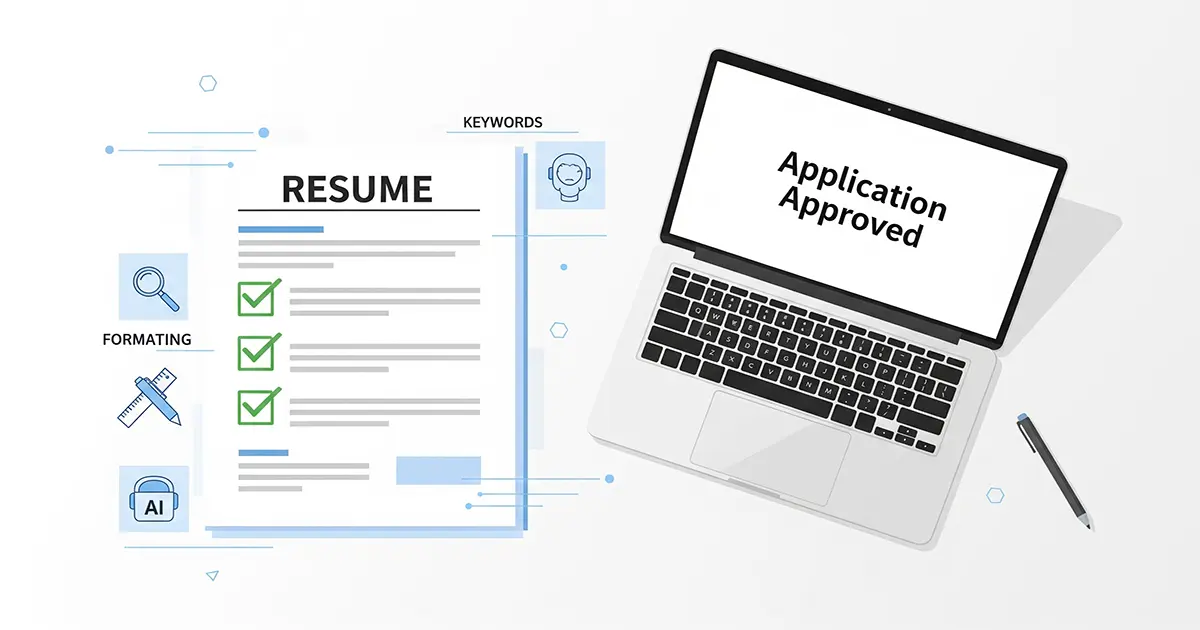
ATS systems are sophisticated software programs that help recruiters manage large volumes of applications. They scan resumes for specific keywords, phrases, and formatting elements that match the job description. Their goal is to filter out unqualified candidates and present a manageable list of top matches to human recruiters.
These systems operate on algorithms that identify patterns and matches, not on AI content detection. Therefore, an ATS won't flag your resume simply because it was drafted with AI. What an ATS will flag, however, is a resume that lacks relevant keywords, has poor formatting, or is otherwise not optimized for its scanning capabilities.
Poorly optimized AI-generated content, such as keyword stuffing or overly generic language that doesn't align with the job description, can still cause your resume to be deprioritized by an ATS. The system doesn't care if a human or AI wrote it; it only cares if it finds the expected information in the right format. For those seeking a structured approach to resume creation, our AI-powered resume builder
How Recruiters Spot AI-Generated Resumes: The Human Factor
Human recruiters are adept at identifying AI-generated resumes through subtle cues that indicate a lack of personalization and genuine voice. They look for specific 'giveaways' such as overly formal language, repetitive phrasing, generic achievements, and a disconnect from the applicant's unique experiences, which often signal content created without a human touch.

Unlike ATS, human recruiters are looking for more than just keywords; they seek authenticity, personality, and a clear narrative. They want to understand who you are, what motivates you, and how your unique experiences align with the role and company culture. AI-generated content, if unedited, often falls short in conveying these human elements.
Recruiters spend seconds on an initial resume review, and their trained eyes quickly pick up on inconsistencies or a lack of specific detail. Generic, boilerplate language that could apply to anyone is a major red flag. They are looking for evidence of critical thinking, problem-solving, and a genuine understanding of the industry, which AI often struggles to replicate authentically.
💡 Tip: Recruiters are inundated with applications. A resume that sounds like every other AI-generated submission will quickly be overlooked. Personalization is your competitive edge.
A significant percentage of hiring managers reject AI-generated resumes that lack personalization, according to SHRM. They value a candidate's ability to articulate their value in their own words, demonstrating communication skills that are essential for most roles. The absence of specific, quantifiable achievements is another major giveaway, as AI often generates vague statements rather than concrete results.
Recruiter Red Flag | What it Looks Like |
|---|
Common AI Resume 'Giveaways' and How to Avoid Them
AI-generated resumes often exhibit common 'giveaways' that signal their origin, including overly formal or robotic language, repetitive sentence structures, and vague statements that lack specific details. To avoid these, job seekers must meticulously review and personalize AI-generated content, injecting their unique experiences, quantifiable achievements, and a natural tone.
One of the most immediate red flags is an unnatural phrasing or tone. AI models, especially older ones, tend to produce text that is grammatically correct but lacks the nuance and flow of human writing. This can manifest as overly formal language, stiff sentence structures, or a robotic cadence that feels out of place for a professional document.
Another common giveaway is repetitive or overly generic language. AI might rephrase the same idea multiple ways or use common buzzwords without providing specific context. This leads to a resume that sounds impressive at first glance but quickly reveals a lack of substance upon closer inspection. Recruiters are looking for unique contributions, not recycled phrases.
Vague or inflated descriptions without concrete examples are also tell-tale signs. AI can easily generate statements like "drove significant growth" or "optimized key processes" but often fails to provide the crucial "how" and "by how much." Without quantifiable achievements, these statements hold little weight and fail to impress hiring managers.
The absence of a unique personal voice or storytelling is perhaps the most significant giveaway. Your resume should reflect your individual career journey, your passions, and your specific contributions. AI, without careful human input, struggles to capture this individuality, resulting in a resume that feels impersonal and interchangeable with other candidates.
Characteristic | AI-Generated (Unedited) |
|---|
Using AI Ethically and Effectively for Your Resume
Leveraging AI for your resume can be a powerful tool, provided it's used ethically and strategically to enhance, not replace, your personal input. Focus on using AI for initial drafting, keyword optimization, and proofreading, but always ensure the final product is thoroughly personalized, reflects your authentic voice, and highlights your unique qualifications and achievements.
The ethical use of AI in resume writing centers on transparency and authenticity. It's perfectly acceptable to use AI for brainstorming ideas, generating initial bullet points, or optimizing for keywords. Think of AI as a highly efficient assistant that can help you overcome writer's block or ensure your resume is ATS-friendly. However, the final output must always be your own, reflecting your true experiences and voice.
Over half of hiring managers value AI for proofreading or drafting but expect a human touch in the final application, according to SHRM. This means your role is to guide the AI, provide it with specific inputs, and then meticulously refine its output. Do not simply copy and paste AI-generated text without critical review.
✅ Best Practice: Treat AI as a co-pilot, not an autopilot. You are always in command of your career narrative.
Personalization is non-negotiable. After AI generates content, go through each line and ask: "Does this accurately represent my experience?" "Is this specific enough?" "Does this sound like me?" Replace generic statements with concrete examples, quantify your achievements with numbers and metrics, and infuse your unique perspective. This human editing process transforms a generic AI draft into a compelling personal statement.
Always proofread meticulously. While AI can catch grammatical errors, it might introduce subtle inaccuracies or awkward phrasing. A final human review ensures accuracy, consistency, and a polished presentation. Cross-check all facts, figures, and dates, as AI can sometimes hallucinate or misinterpret information.
Brainstorm initial ideas and keywords related to the job description.
Generate draft bullet points for your experience section, then refine them with specific achievements.
Use AI to check for keyword optimization against the job description, ensuring ATS compatibility.
Get suggestions for different ways to phrase your skills and accomplishments.
Utilize AI for grammar and spelling checks, but always perform a final human proofread.
Tailor AI-assisted content to each specific job description, making it highly relevant.
Beyond the Resume: AI's Role in Your Job Search Strategy
AI extends beyond resume creation, offering valuable support throughout the entire job search process, from optimizing your LinkedIn profile to preparing for interviews. Tools can help with crafting compelling cover letters, practicing interview responses, and even identifying suitable job openings, but human oversight and personalization remain critical for success.
Your LinkedIn profile is often the first place recruiters look after reviewing your resume. AI can help optimize your profile summary and experience sections with relevant keywords, making you more discoverable. It can suggest improvements to your headline and 'About' section to better reflect your professional brand and career aspirations.
Furthermore, AI-powered job search platforms can help you identify relevant job openings that you might otherwise miss. These tools can analyze your resume and preferences to suggest roles that align with your skills and career goals, streamlining your job search efforts. However, always critically evaluate these suggestions and conduct your own research into the companies and roles.
The key across all these applications is to use AI as an augmentation tool, not a replacement for your own critical thinking and personal touch. Many recruiters are being inundated with AI-generated applications, making personalization crucial for job seekers, as noted by LinkedIn. Your unique voice and genuine interest are what will ultimately differentiate you.
🎯 Key Takeaways
ATS systems primarily screen for keywords, not AI authorship.
Human recruiters detect AI-generated resumes through lack of personalization and generic language.
Overly formal tone, vague achievements, and repetitive phrasing are common AI giveaways.
Use AI for drafting and optimization, but always personalize and proofread thoroughly.
Ethical AI use means enhancing your application, not replacing your unique voice.
AI tools can assist with cover letters and interview prep, but human oversight is crucial.
Frequently Asked Questions
How do recruiters detect AI-generated resumes?
Recruiters detect AI-generated resumes by looking for a lack of personalization, generic phrasing, and an absence of a unique personal voice. They often spot overly formal or robotic language, repetitive sentence structures, and vague descriptions that don't highlight specific, quantifiable achievements. A resume that sounds like it could belong to anyone, rather than a specific individual with unique experiences, is a major red flag for human reviewers.
What are the signs of an unpersonalized AI resume?
Signs of an unpersonalized AI resume include generic action verbs, boilerplate descriptions that lack specific context, and a failure to connect skills directly to the job description's requirements. It often uses common AI phrases, lacks genuine storytelling, and doesn't convey enthusiasm or a deep understanding of the target company or role. Such resumes typically feel sterile and fail to showcase the candidate's unique value proposition.
Can ATS systems identify AI-written resumes?
No, Applicant Tracking Systems (ATS) are not designed to identify AI-written resumes. Their primary function is to scan for keywords, format compatibility, and relevance to the job description. While an ATS might flag a resume for keyword stuffing or poor formatting, it cannot determine if the content was generated by artificial intelligence. The detection of AI-generated content falls to human recruiters during their review process.
How to make your AI-generated resume appear human-written?
To make your AI-generated resume appear human-written, you must personalize every section. Inject specific, quantifiable achievements, use a natural and authentic tone, and tailor the language to reflect your unique experiences and the company culture. Remove any overly formal or generic AI phrasing, and ensure the resume tells a coherent story about your career trajectory and aspirations. Thorough proofreading and editing are also essential.
Is it ethical to use AI to write my resume and cover letter?
Using AI to assist with your resume and cover letter is generally considered ethical, provided you use it as a tool for enhancement and not as a complete replacement for your own input. It becomes unethical if you present entirely AI-generated content as your own without any personalization, leading to misrepresentation or a lack of authenticity. The key is to leverage AI for drafting, optimization, and proofreading, while ensuring the final submission genuinely reflects your skills, experiences, and voice.
What are common mistakes when using AI for job applications?
Common mistakes when using AI for job applications include submitting unedited, generic AI-generated content, failing to personalize the resume for specific roles, and relying solely on AI without human review. Other errors include keyword stuffing, using overly formal or robotic language, and not cross-checking facts or figures generated by AI. These mistakes often result in a resume that lacks authenticity and fails to impress recruiters.
How do I personalize AI-generated content for job applications?
Personalizing AI-generated content involves several steps: first, replace generic statements with specific examples from your career, quantifying achievements whenever possible. Second, adjust the tone to match your personality and the company's culture. Third, explicitly connect your skills and experiences to the job description's requirements, using relevant keywords naturally. Finally, add unique insights or experiences that only you possess, making the content distinctly yours.
What are the best free AI tools for job searching?
Several free AI tools can assist with job searching. ChatGPT and Google Bard are excellent for brainstorming, drafting bullet points, and generating initial content. Grammarly's AI features can help with proofreading and refining language. Tools like Jobscan offer free resume scanning to check for ATS compatibility and keyword optimization. While many advanced features are paid, these free options provide a solid foundation for leveraging AI in your job search.
The question of whether AI-generated resumes are easily detected is a critical concern for job seekers looking to leverage technology without compromising their chances. While Applicant Tracking Systems (ATS) are not designed to identify AI-written content, human recruiters are increasingly adept at spotting the tell-tale signs of a resume lacking a genuine human touch. Understanding this distinction is crucial for effectively using AI as a tool to enhance your job application, rather than letting it undermine your authenticity.
Can ATS Systems Detect AI-Generated Resumes?
While Applicant Tracking Systems (ATS) are highly effective at parsing resumes for keywords and formatting, they are generally not designed to detect whether content was generated by AI. Their primary function is to screen for relevance to the job description, not authorship. However, generic or keyword-stuffed AI content can still hinder a resume's performance within an ATS.
ATS systems are sophisticated software programs that help recruiters manage large volumes of applications. They scan resumes for specific keywords, phrases, and formatting elements that match the job description. Their goal is to filter out unqualified candidates and present a manageable list of top matches to human recruiters.
These systems operate on algorithms that identify patterns and matches, not on AI content detection. Therefore, an ATS won't flag your resume simply because it was drafted with AI. What an ATS will flag, however, is a resume that lacks relevant keywords, has poor formatting, or is otherwise not optimized for its scanning capabilities.
Poorly optimized AI-generated content, such as keyword stuffing or overly generic language that doesn't align with the job description, can still cause your resume to be deprioritized by an ATS. The system doesn't care if a human or AI wrote it; it only cares if it finds the expected information in the right format. For those seeking a structured approach to resume creation, our AI-powered resume builder
How Recruiters Spot AI-Generated Resumes: The Human Factor
Human recruiters are adept at identifying AI-generated resumes through subtle cues that indicate a lack of personalization and genuine voice. They look for specific 'giveaways' such as overly formal language, repetitive phrasing, generic achievements, and a disconnect from the applicant's unique experiences, which often signal content created without a human touch.
Unlike ATS, human recruiters are looking for more than just keywords; they seek authenticity, personality, and a clear narrative. They want to understand who you are, what motivates you, and how your unique experiences align with the role and company culture. AI-generated content, if unedited, often falls short in conveying these human elements.
Recruiters spend seconds on an initial resume review, and their trained eyes quickly pick up on inconsistencies or a lack of specific detail. Generic, boilerplate language that could apply to anyone is a major red flag. They are looking for evidence of critical thinking, problem-solving, and a genuine understanding of the industry, which AI often struggles to replicate authentically.
💡 Tip: Recruiters are inundated with applications. A resume that sounds like every other AI-generated submission will quickly be overlooked. Personalization is your competitive edge.
A significant percentage of hiring managers reject AI-generated resumes that lack personalization, according to SHRM. They value a candidate's ability to articulate their value in their own words, demonstrating communication skills that are essential for most roles. The absence of specific, quantifiable achievements is another major giveaway, as AI often generates vague statements rather than concrete results.
Recruiter Red Flag
What it Looks Like
How to Avoid
Generic Phrasing
Uses vague terms like "responsible for," "contributed to," "leveraged synergies" without specific context.
Replace with strong action verbs and specific examples. Quantify achievements.
Lack of Quantifiable Results
Statements like "improved efficiency" instead of "improved efficiency by 15% through process automation."
Always include numbers, percentages, or metrics to demonstrate impact.
Overly Formal Tone
Reads like a textbook or academic paper, lacking natural flow or conversational elements.
Inject your personality. Use language that sounds like you, while remaining professional.
Repetitive Content
Similar bullet points or phrases appearing across different roles or sections.
Vary your language and focus on unique contributions for each role.
No Personal Story
The resume doesn't convey a clear career path, motivations, or unique skills beyond the job description.
Craft a compelling summary and tailor experiences to tell your unique professional journey.
Common AI Resume 'Giveaways' and How to Avoid Them
AI-generated resumes often exhibit common 'giveaways' that signal their origin, including overly formal or robotic language, repetitive sentence structures, and vague statements that lack specific details. To avoid these, job seekers must meticulously review and personalize AI-generated content, injecting their unique experiences, quantifiable achievements, and a natural tone.
One of the most immediate red flags is an unnatural phrasing or tone. AI models, especially older ones, tend to produce text that is grammatically correct but lacks the nuance and flow of human writing. This can manifest as overly formal language, stiff sentence structures, or a robotic cadence that feels out of place for a professional document.
Another common giveaway is repetitive or overly generic language. AI might rephrase the same idea multiple ways or use common buzzwords without providing specific context. This leads to a resume that sounds impressive at first glance but quickly reveals a lack of substance upon closer inspection. Recruiters are looking for unique contributions, not recycled phrases.
Vague or inflated descriptions without concrete examples are also tell-tale signs. AI can easily generate statements like "drove significant growth" or "optimized key processes" but often fails to provide the crucial "how" and "by how much." Without quantifiable achievements, these statements hold little weight and fail to impress hiring managers.
The absence of a unique personal voice or storytelling is perhaps the most significant giveaway. Your resume should reflect your individual career journey, your passions, and your specific contributions. AI, without careful human input, struggles to capture this individuality, resulting in a resume that feels impersonal and interchangeable with other candidates.
Characteristic
AI-Generated (Unedited)
Human-Edited (Personalized)
Language Tone
Overly formal, academic, or robotic; lacks natural flow.
Professional yet authentic; reflects personal communication style.
Achievement Description
Vague statements like "improved efficiency" or "managed projects."
Specific, quantifiable results: "Increased efficiency by 20% through implementing new CRM system, saving $50K annually."
Specificity
General industry buzzwords; could apply to many candidates.
Details unique projects, challenges, and solutions specific to your experience.
Personal Voice
Absent; sounds like a template or generic output.
Evident; conveys enthusiasm, unique perspective, and career narrative.
Keywords
Potentially stuffed or used without natural integration.
Strategically placed and naturally integrated within context.
Using AI Ethically and Effectively for Your Resume
Leveraging AI for your resume can be a powerful tool, provided it's used ethically and strategically to enhance, not replace, your personal input. Focus on using AI for initial drafting, keyword optimization, and proofreading, but always ensure the final product is thoroughly personalized, reflects your authentic voice, and highlights your unique qualifications and achievements.
The ethical use of AI in resume writing centers on transparency and authenticity. It's perfectly acceptable to use AI for brainstorming ideas, generating initial bullet points, or optimizing for keywords. Think of AI as a highly efficient assistant that can help you overcome writer's block or ensure your resume is ATS-friendly. However, the final output must always be your own, reflecting your true experiences and voice.
Over half of hiring managers value AI for proofreading or drafting but expect a human touch in the final application, according to SHRM. This means your role is to guide the AI, provide it with specific inputs, and then meticulously refine its output. Do not simply copy and paste AI-generated text without critical review.
✅ Best Practice: Treat AI as a co-pilot, not an autopilot. You are always in command of your career narrative.
Personalization is non-negotiable. After AI generates content, go through each line and ask: "Does this accurately represent my experience?" "Is this specific enough?" "Does this sound like me?" Replace generic statements with concrete examples, quantify your achievements with numbers and metrics, and infuse your unique perspective. This human editing process transforms a generic AI draft into a compelling personal statement.
Always proofread meticulously. While AI can catch grammatical errors, it might introduce subtle inaccuracies or awkward phrasing. A final human review ensures accuracy, consistency, and a polished presentation. Cross-check all facts, figures, and dates, as AI can sometimes hallucinate or misinterpret information.
Brainstorm initial ideas and keywords related to the job description.
Generate draft bullet points for your experience section, then refine them with specific achievements.
Use AI to check for keyword optimization against the job description, ensuring ATS compatibility.
Get suggestions for different ways to phrase your skills and accomplishments.
Utilize AI for grammar and spelling checks, but always perform a final human proofread.
Tailor AI-assisted content to each specific job description, making it highly relevant.
Beyond the Resume: AI's Role in Your Job Search Strategy
AI extends beyond resume creation, offering valuable support throughout the entire job search process, from optimizing your LinkedIn profile to preparing for interviews. Tools can help with crafting compelling cover letters, practicing interview responses, and even identifying suitable job openings, but human oversight and personalization remain critical for success.
Your LinkedIn profile is often the first place recruiters look after reviewing your resume. AI can help optimize your profile summary and experience sections with relevant keywords, making you more discoverable. It can suggest improvements to your headline and 'About' section to better reflect your professional brand and career aspirations.
AI can also be a significant asset when crafting compelling cover letters
Beyond the initial application, AI for interview preparation
Furthermore, AI-powered job search platforms can help you identify relevant job openings that you might otherwise miss. These tools can analyze your resume and preferences to suggest roles that align with your skills and career goals, streamlining your job search efforts. However, always critically evaluate these suggestions and conduct your own research into the companies and roles.
The key across all these applications is to use AI as an augmentation tool, not a replacement for your own critical thinking and personal touch. Many recruiters are being inundated with AI-generated applications, making personalization crucial for job seekers, as noted by LinkedIn. Your unique voice and genuine interest are what will ultimately differentiate you.