Your resume is often the first impression you make on a potential employer, and mastering effective resume writing tips is crucial for standing out. This document must clearly articulate your value, skills, and experience in a way that appeals to both Applicant Tracking Systems (ATS) and human recruiters. A well-crafted resume is your most powerful tool for securing interviews and advancing your career.
Mastering the Basics: Key Elements of a Strong Resume
A strong resume clearly highlights your qualifications, experience, and skills in a concise, easy-to-read format. It acts as your professional marketing document, designed to capture a recruiter's attention and demonstrate your fit for the role by showcasing relevant achievements and a clear career trajectory.
Every effective resume begins with accurate and accessible professional contact information. This includes your full name, phone number, professional email address, and a link to your LinkedIn profile. Ensure this information is prominently displayed and easy to find.
Following your contact details, a compelling resume summary or objective statement provides a brief, impactful overview of your career. A summary is best for experienced professionals, highlighting key achievements and skills, while an objective suits entry-level candidates or those changing careers, stating their career goals and relevant transferable skills.
The work experience section is the core of your resume, detailing your professional history. For each role, include your job title, company name, location, and dates of employment. Crucially, use bullet points to describe your responsibilities and, more importantly, your quantifiable achievements.
Your education and certifications section should list degrees, institutions, graduation dates (or expected dates), and any relevant certifications. For recent graduates, consider including academic honors or significant projects. For a streamlined process, consider using Placed's Resume Builder to ensure all essential elements are included and formatted correctly.
Finally, a dedicated key skills section allows you to showcase both your hard skills (technical abilities, software proficiency) and soft skills (communication, leadership, problem-solving). Tailor this section to reflect the skills most relevant to the jobs you are applying for.
📌 Checklist: Essential Resume Elements
Professional Contact Information (Name, Phone, Email, LinkedIn)
Compelling Resume Summary or Objective
Relevant Work Experience with Quantifiable Achievements
Education and Certifications
Key Skills Section (Hard and Soft Skills)
Unlock Opportunities: Tailoring Your Resume for Every Application
Tailoring your resume means customizing its content to specifically match the requirements and keywords of each job description. This critical step significantly increases your chances of passing Applicant Tracking Systems (ATS) and resonating with hiring managers, demonstrating your direct relevance to the role.
Start by thoroughly analyzing the job description for keywords and required skills. Identify the specific terms and phrases the employer uses to describe the role, responsibilities, and desired qualifications. These are the resume keywords you need to integrate.
Next, customize your resume summary or objective to directly address the employer's needs outlined in the job posting. Instead of a generic statement, highlight how your unique skills and experiences align with their specific requirements. This immediate connection grabs attention.
Reorder your experience bullet points to highlight the most relevant achievements first for each role. If a job description emphasizes project management, ensure your project management accomplishments are at the top of your bullet list for that position, even if they weren't your primary duty.
Adjust your skills section to mirror the job posting's language. If the job description lists "CRM software proficiency," use that exact phrase rather than a generic "customer relationship management." This direct match is crucial for ATS and human readers alike. Pair your optimized resume with a strong, tailored cover letter; our cover letter writing guide can help you craft one that complements your application.
Finally, use specific examples in your experience section that align with the company's values or industry needs. Research the company to understand its mission and culture, then weave in examples that demonstrate how you embody those traits or have contributed to similar industry challenges.
Action Item | Why It Matters |
|---|
Beat the Bots: Crafting an ATS-Friendly Resume
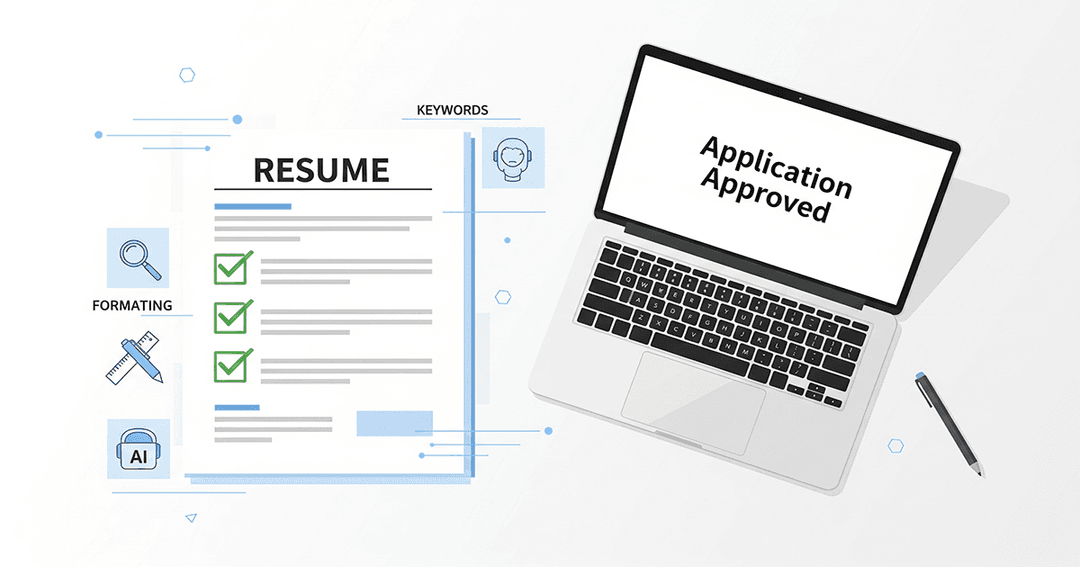
An ATS-friendly resume is formatted and structured in a way that Applicant Tracking Systems can easily parse and interpret, ensuring your application doesn't get overlooked. This involves using standard headings, simple layouts, and strategically incorporating keywords from the job description.

Understanding how ATS works is fundamental. These systems don't just count keywords; they perform semantic matching, looking for context and related terms. While keyword density is important, natural language integration is key. Approximately 75% of resumes are rejected by Applicant Tracking Systems (ATS) before reaching a human recruiter, according to Jobscan.
Choose simple, clean resume templates. A single-column format is generally preferred as it's easiest for ATS to read. Avoid complex designs, multiple columns, or intricate graphics that can scramble the parsing process. Recruiters spend an average of 6-7 seconds reviewing a resume, according to Indeed, so clarity is paramount.
Use standard section headings like 'Work Experience', 'Education', 'Skills', and 'Summary'. Creative or unusual headings might confuse the ATS, preventing it from categorizing your information correctly. Consistency in heading names is vital.
Avoid graphics, tables, text boxes, and embedded images. While visually appealing to humans, these elements are often unreadable by ATS and can lead to crucial information being missed. Stick to plain text within the main body of the document.
Incorporate relevant keywords naturally throughout your content, not just in a dedicated keyword list. Weave them into your experience bullet points, summary, and skills section. This demonstrates both your proficiency and your understanding of the role's requirements. Before submitting, run your resume through an AI Resume Review tool to catch any potential ATS red flags.
📋 Steps: Ensuring ATS Compatibility
Research job descriptions for target keywords.
Select a clean, single-column resume template.
Use standard section headings (e.g., "Experience," "Education").
Avoid graphics, tables, and text boxes.
Integrate keywords naturally into your content.
Save your resume as a .docx or plain text file.
Show, Don't Just Tell: Leveraging Action Verbs and Quantifiable Achievements
To make your resume impactful, use strong action verbs to start bullet points and quantify your achievements with numbers, percentages, or specific outcomes. This approach transforms passive descriptions into compelling evidence of your capabilities and the value you bring to a role.
Powerful action verbs for resume writing convey energy and initiative. Instead of saying "Responsible for managing projects," use "Managed cross-functional projects," or "Led a team of five." These verbs immediately communicate your direct involvement and impact. Tailor your verbs to the industry and specific role.
Quantifying accomplishments is non-negotiable. Recruiters want to see tangible results. Instead of "Improved customer satisfaction," write "Increased customer satisfaction by 15% through new feedback protocols." Resumes with quantifiable achievements are 40% more likely to get an interview, according to Resume Genius.
Techniques for quantifiable achievements resume include using percentages, dollar amounts, specific numbers of people managed, or time saved. Even in roles that don't directly involve sales or revenue, you can quantify by focusing on efficiency gains, process improvements, or the scale of your responsibilities.
The STAR method (Situation, Task, Action, Result) is an excellent framework for structuring your achievements. Briefly describe the situation, your task, the action you took, and the measurable result. This provides context and demonstrates your problem-solving abilities and impact.
For example, instead of a weak statement like "Handled social media," a strong achievement would be: "Developed and executed a new social media strategy, increasing engagement by 25% and growing follower count by 10,000 within six months." This clearly shows the action and its positive outcome.
💡 Tip: Quantifying Non-Sales Roles
Customer Service: "Resolved 50+ customer inquiries daily, maintaining a 98% satisfaction rate."
Administrative: "Streamlined office supply ordering, reducing costs by 10% annually."
Education: "Designed and delivered curriculum to 150 students, resulting in a 90% pass rate."
Common Resume Mistakes to Avoid (and How to Fix Them)
Avoiding common resume pitfalls is as crucial as including essential elements. Mistakes like typos, generic content, excessive length, or poor formatting can quickly lead to disqualification. Proactive proofreading and strategic content choices are key to presenting a polished, professional application.
Typos and grammatical errors are immediate red flags. They signal a lack of attention to detail. Always proofread your resume multiple times, and ideally, have someone else review it. Even better, read it backward or aloud to catch mistakes your eyes might skip over.
Generic content that doesn't stand out fails to impress. Avoid vague statements and instead, tailor your resume to each specific job description. Highlight skills and experiences directly relevant to the role, demonstrating why you are the ideal candidate.
Overly long or dense resumes deter recruiters. Aim for one page for most professionals, or two pages for those with extensive experience. Use concise language and bullet points to convey information efficiently. Every word should earn its place.
Inconsistent formatting or fonts make your resume look unprofessional and can confuse ATS. Stick to one or two professional fonts and maintain consistent sizing and spacing throughout the document. This attention to detail reflects positively on your professionalism.
Including irrelevant personal information, such as marital status, religion, or a photo (unless specifically requested for international applications), is unnecessary and can lead to unconscious bias. Focus solely on your professional qualifications. Ensure your resume content aligns perfectly with your LinkedIn profile by implementing effective LinkedIn optimization strategies.
Outdated contact details mean missed opportunities. Double-check your phone number and email address before every submission. Similarly, not updating your resume regularly means you're not showcasing your most recent and relevant accomplishments.
⚠️ Common Resume Mistakes Checklist
❌ Typos and grammatical errors
❌ Generic, untailored content
❌ Overly long or dense document
❌ Inconsistent formatting or fonts
❌ Irrelevant personal information
❌ Outdated contact details
❌ Lack of quantifiable achievements
Ethical AI Use: Enhancing Your Resume Without Losing Your Voice
AI tools can significantly streamline resume writing and optimization, but ethical and effective use requires personalization and critical review. Leveraging AI for keyword identification, grammar checks, or initial drafts can be beneficial, provided the final output genuinely reflects your unique skills and experiences.

AI tools can be powerful for AI resume optimization by assisting with keyword extraction. Paste a job description into an AI tool, and it can highlight the most frequently used and important terms, helping you ensure your resume is aligned with what the ATS is looking for. This saves time and increases accuracy.
Using AI for grammar and spell-checking is a highly effective and ethical application. Tools like Grammarly or built-in word processor checkers can catch errors that human eyes might miss, ensuring your resume is polished and professional. This is a foundational step in quality control.
AI can also generate initial bullet point ideas or summary statements based on your input. Provide it with your raw experience, and it can suggest ways to phrase accomplishments using strong action verbs. However, these are starting points; they require your expertise to refine and personalize.
Personalizing AI-generated content is crucial to maintain authenticity. Never copy and paste AI output directly. Review every suggestion, edit it to reflect your unique experiences and voice, and ensure it accurately represents your contributions. Your resume should sound like you, not a machine.
Avoid over-reliance on AI that leads to generic resumes. If you use AI to generate an entire resume without significant human input, it will likely lack the specific details, nuances, and personal touch that make a candidate stand out. Generic resumes are easily dismissed by human recruiters.
Understanding the limitations of AI in capturing nuance is important. AI excels at pattern recognition and language generation but struggles with understanding the subtle context of your career journey or the specific culture of a company. Your human judgment is indispensable for crafting a truly compelling application.
Pros of AI in Resume Writing | Cons of AI in Resume Writing |
|---|---|
Crafting an effective resume is an ongoing process that requires attention to detail, strategic tailoring, and a clear understanding of modern hiring practices. By implementing these resume writing tips, you can significantly improve your chances of getting past ATS and making a strong impression on hiring managers. Remember, your resume is a dynamic document that should evolve with your career and adapt to each opportunity.
Take the time to refine your resume for every application, focusing on quantifiable achievements and relevant keywords. If you find yourself needing more personalized support or advanced strategies, connecting with a career mentorship professional can provide invaluable guidance. Your dream job is within reach with a resume that truly reflects your potential.
🎯 Key Takeaways
Tailor your resume for each job application to bypass ATS and impress recruiters.
Quantify your achievements with metrics and strong action verbs to demonstrate impact.
Choose simple, clean resume formats and standard headings for ATS compatibility.
Leverage AI tools ethically for keyword identification and grammar checks, but always personalize.
Proofread meticulously and ensure consistency across all your professional profiles.
Focus on relevant experience and skills, avoiding generic content and unnecessary details.
Frequently Asked Questions
How do I make my resume ATS friendly?
To make your resume ATS friendly, use a clean, simple format with standard headings like "Work Experience" and "Education." Avoid complex graphics, tables, or text boxes that can confuse the system. Incorporate keywords directly from the job description naturally throughout your resume, especially in your experience bullet points and skills section. Ensure consistent formatting and font usage, as ATS struggles with inconsistencies.
What are the key elements of a strong resume?
A strong resume includes professional contact information, a compelling summary or objective tailored to the role, and a detailed work experience section with quantifiable achievements. It also features relevant education and certifications, and a dedicated skills section highlighting both hard and soft skills pertinent to the job. Each element should be concise and directly support your candidacy.
How can I use AI to improve my resume?
AI tools can assist with keyword extraction from job descriptions, identify grammatical errors, and even suggest initial bullet point ideas. You can use AI to analyze your resume's ATS compatibility or generate a first draft of a summary. However, always personalize and critically review AI-generated content to ensure it accurately reflects your unique experiences and voice, avoiding generic outputs.
What are common resume mistakes to avoid?
Common resume mistakes include typos and grammatical errors, using generic content not tailored to the job, and submitting an overly long or dense document. Inconsistent formatting, including irrelevant personal information, or outdated contact details are also frequent errors. Failing to update your resume regularly or not proofreading thoroughly can significantly hinder your job search.
Should I include a summary or objective on my resume?
For most job seekers, a resume summary is more effective than an objective. A summary highlights your key qualifications, experience, and career achievements, demonstrating immediate value to the employer. An objective, which states what you are seeking, is generally only appropriate for entry-level candidates or those making a significant career change, where explaining your career goals is crucial.
How do I find relevant keywords for my resume?
To find relevant keywords, thoroughly analyze the job description for the specific role you're targeting. Pay close attention to job titles, responsibilities, required skills, and qualifications. Look for terms that appear repeatedly. You can also research similar job postings and industry-specific language. Integrate these keywords naturally into your resume's experience, skills, and summary sections.
What are the best action verbs to use on a resume?
The best action verbs are strong, descriptive, and convey impact. They vary by industry but generally include words like "managed," "developed," "implemented," "analyzed," "led," "optimized," "generated," "collaborated," and "streamlined." These verbs help to articulate your accomplishments clearly and powerfully, making your contributions stand out to recruiters.
How can I quantify my achievements on a resume?
Quantifying achievements means expressing your accomplishments with numbers, percentages, or specific results. Instead of saying "managed projects," say "managed 10+ projects, delivering 95% on time and under budget." Even in non-sales roles, you can quantify by focusing on efficiency gains, cost savings, time reductions, or the scale of your responsibilities (e.g., "supported a team of 20").
Do AI scanners actually work for resumes?
Yes, AI scanners, primarily Applicant Tracking Systems (ATS), are highly effective and widely used by companies to filter resumes. They work by parsing resumes for keywords, specific phrases, and formatting elements to determine a candidate's match against job requirements. While they don't "reject" resumes in a human sense, they rank them, and low-ranking resumes are often never seen by a human recruiter.
How often should I update my resume?
You should update your resume whenever you gain new experience, acquire new skills, complete significant projects, or achieve new certifications. Even if you're not actively job searching, a quarterly review helps keep it current. This proactive approach ensures your resume is always ready for unexpected opportunities and accurately reflects your most recent accomplishments.
What's the ideal length for a resume?
For most professionals with less than 10 years of experience, a one-page resume is ideal. If you have extensive experience, multiple roles, or a highly specialized career, a two-page resume can be acceptable. The key is conciseness and relevance; every piece of information should add value and directly support your candidacy for the target role.
Is it good to use AI for job applications?
Using AI for job applications can be beneficial for tasks like identifying keywords, optimizing resume phrasing, or generating initial drafts of cover letters. It can save time and help ensure your application aligns with job descriptions. However, it's crucial to use AI as a tool for enhancement, not replacement. Always review, personalize, and refine AI-generated content to maintain authenticity and avoid generic submissions that lack your unique voice and specific experiences.
Your resume is often the first impression you make on a potential employer, and mastering effective resume writing tips is crucial for standing out. This document must clearly articulate your value, skills, and experience in a way that appeals to both Applicant Tracking Systems (ATS) and human recruiters. A well-crafted resume is your most powerful tool for securing interviews and advancing your career.
Mastering the Basics: Key Elements of a Strong Resume
A strong resume clearly highlights your qualifications, experience, and skills in a concise, easy-to-read format. It acts as your professional marketing document, designed to capture a recruiter's attention and demonstrate your fit for the role by showcasing relevant achievements and a clear career trajectory.
Every effective resume begins with accurate and accessible professional contact information. This includes your full name, phone number, professional email address, and a link to your LinkedIn profile. Ensure this information is prominently displayed and easy to find.
Following your contact details, a compelling resume summary or objective statement provides a brief, impactful overview of your career. A summary is best for experienced professionals, highlighting key achievements and skills, while an objective suits entry-level candidates or those changing careers, stating their career goals and relevant transferable skills.
The work experience section is the core of your resume, detailing your professional history. For each role, include your job title, company name, location, and dates of employment. Crucially, use bullet points to describe your responsibilities and, more importantly, your quantifiable achievements.
Your education and certifications section should list degrees, institutions, graduation dates (or expected dates), and any relevant certifications. For recent graduates, consider including academic honors or significant projects. For a streamlined process, consider using Placed's Resume Builder to ensure all essential elements are included and formatted correctly.
Finally, a dedicated key skills section allows you to showcase both your hard skills (technical abilities, software proficiency) and soft skills (communication, leadership, problem-solving). Tailor this section to reflect the skills most relevant to the jobs you are applying for.
📌 Checklist: Essential Resume Elements
Professional Contact Information (Name, Phone, Email, LinkedIn)
Compelling Resume Summary or Objective
Relevant Work Experience with Quantifiable Achievements
Education and Certifications
Key Skills Section (Hard and Soft Skills)
Unlock Opportunities: Tailoring Your Resume for Every Application
Tailoring your resume means customizing its content to specifically match the requirements and keywords of each job description. This critical step significantly increases your chances of passing Applicant Tracking Systems (ATS) and resonating with hiring managers, demonstrating your direct relevance to the role.
Start by thoroughly analyzing the job description for keywords and required skills. Identify the specific terms and phrases the employer uses to describe the role, responsibilities, and desired qualifications. These are the resume keywords you need to integrate.
Next, customize your resume summary or objective to directly address the employer's needs outlined in the job posting. Instead of a generic statement, highlight how your unique skills and experiences align with their specific requirements. This immediate connection grabs attention.
Reorder your experience bullet points to highlight the most relevant achievements first for each role. If a job description emphasizes project management, ensure your project management accomplishments are at the top of your bullet list for that position, even if they weren't your primary duty.
Adjust your skills section to mirror the job posting's language. If the job description lists "CRM software proficiency," use that exact phrase rather than a generic "customer relationship management." This direct match is crucial for ATS and human readers alike. Pair your optimized resume with a strong, tailored cover letter; our cover letter writing guide can help you craft one that complements your application.
Finally, use specific examples in your experience section that align with the company's values or industry needs. Research the company to understand its mission and culture, then weave in examples that demonstrate how you embody those traits or have contributed to similar industry challenges.
Action Item
Why It Matters
Completion Status
Identify keywords from job description
Ensures ATS compatibility and relevance
☐
Update resume summary/objective
Grabs recruiter attention immediately
☐
Reorder experience bullet points
Highlights most relevant experience first
☐
Adjust skills section
Directly matches job posting requirements
☐
Quantify achievements with specific examples
Demonstrates impact and value
☐
Beat the Bots: Crafting an ATS-Friendly Resume
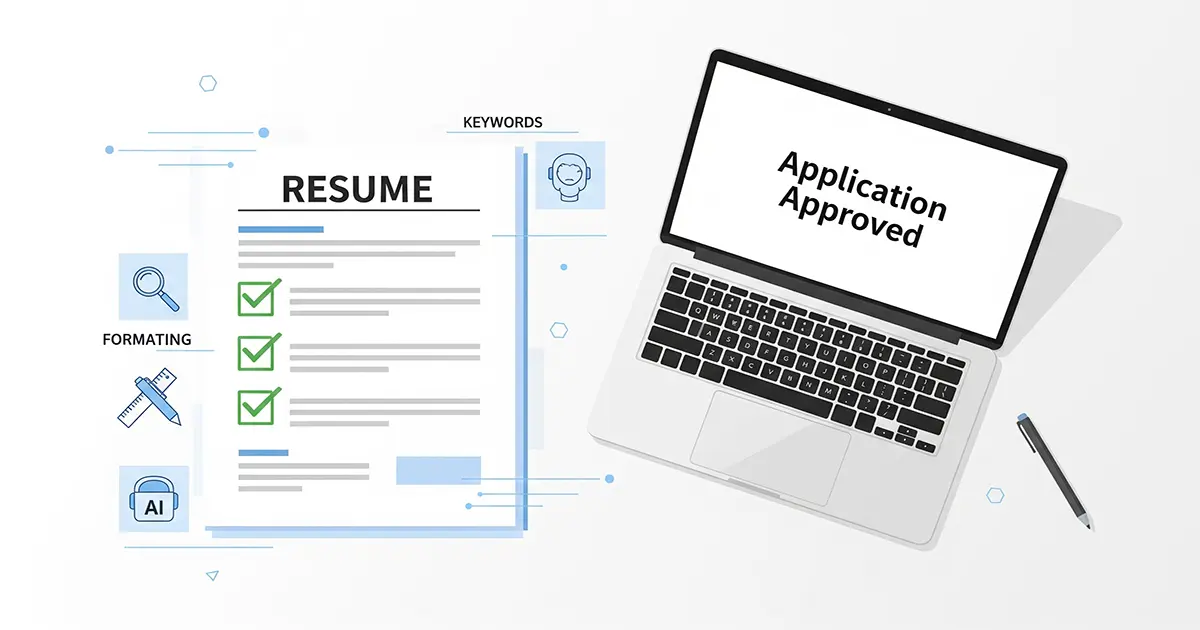
An ATS-friendly resume is formatted and structured in a way that Applicant Tracking Systems can easily parse and interpret, ensuring your application doesn't get overlooked. This involves using standard headings, simple layouts, and strategically incorporating keywords from the job description.
Understanding how ATS works is fundamental. These systems don't just count keywords; they perform semantic matching, looking for context and related terms. While keyword density is important, natural language integration is key. Approximately 75% of resumes are rejected by Applicant Tracking Systems (ATS) before reaching a human recruiter, according to Jobscan.
Choose simple, clean resume templates. A single-column format is generally preferred as it's easiest for ATS to read. Avoid complex designs, multiple columns, or intricate graphics that can scramble the parsing process. Recruiters spend an average of 6-7 seconds reviewing a resume, according to Indeed, so clarity is paramount.
Use standard section headings like 'Work Experience', 'Education', 'Skills', and 'Summary'. Creative or unusual headings might confuse the ATS, preventing it from categorizing your information correctly. Consistency in heading names is vital.
Avoid graphics, tables, text boxes, and embedded images. While visually appealing to humans, these elements are often unreadable by ATS and can lead to crucial information being missed. Stick to plain text within the main body of the document.
Incorporate relevant keywords naturally throughout your content, not just in a dedicated keyword list. Weave them into your experience bullet points, summary, and skills section. This demonstrates both your proficiency and your understanding of the role's requirements. Before submitting, run your resume through an AI Resume Review tool to catch any potential ATS red flags.
📋 Steps: Ensuring ATS Compatibility
Research job descriptions for target keywords.
Select a clean, single-column resume template.
Use standard section headings (e.g., "Experience," "Education").
Avoid graphics, tables, and text boxes.
Integrate keywords naturally into your content.
Save your resume as a .docx or plain text file.
Show, Don't Just Tell: Leveraging Action Verbs and Quantifiable Achievements
To make your resume impactful, use strong action verbs to start bullet points and quantify your achievements with numbers, percentages, or specific outcomes. This approach transforms passive descriptions into compelling evidence of your capabilities and the value you bring to a role.
Powerful action verbs for resume writing convey energy and initiative. Instead of saying "Responsible for managing projects," use "Managed cross-functional projects," or "Led a team of five." These verbs immediately communicate your direct involvement and impact. Tailor your verbs to the industry and specific role.
Quantifying accomplishments is non-negotiable. Recruiters want to see tangible results. Instead of "Improved customer satisfaction," write "Increased customer satisfaction by 15% through new feedback protocols." Resumes with quantifiable achievements are 40% more likely to get an interview, according to Resume Genius.
Techniques for quantifiable achievements resume include using percentages, dollar amounts, specific numbers of people managed, or time saved. Even in roles that don't directly involve sales or revenue, you can quantify by focusing on efficiency gains, process improvements, or the scale of your responsibilities.
The STAR method (Situation, Task, Action, Result) is an excellent framework for structuring your achievements. Briefly describe the situation, your task, the action you took, and the measurable result. This provides context and demonstrates your problem-solving abilities and impact.
For example, instead of a weak statement like "Handled social media," a strong achievement would be: "Developed and executed a new social media strategy, increasing engagement by 25% and growing follower count by 10,000 within six months." This clearly shows the action and its positive outcome.
💡 Tip: Quantifying Non-Sales Roles
Customer Service: "Resolved 50+ customer inquiries daily, maintaining a 98% satisfaction rate."
Administrative: "Streamlined office supply ordering, reducing costs by 10% annually."
Education: "Designed and delivered curriculum to 150 students, resulting in a 90% pass rate."
Common Resume Mistakes to Avoid (and How to Fix Them)
Avoiding common resume pitfalls is as crucial as including essential elements. Mistakes like typos, generic content, excessive length, or poor formatting can quickly lead to disqualification. Proactive proofreading and strategic content choices are key to presenting a polished, professional application.
Typos and grammatical errors are immediate red flags. They signal a lack of attention to detail. Always proofread your resume multiple times, and ideally, have someone else review it. Even better, read it backward or aloud to catch mistakes your eyes might skip over.
Generic content that doesn't stand out fails to impress. Avoid vague statements and instead, tailor your resume to each specific job description. Highlight skills and experiences directly relevant to the role, demonstrating why you are the ideal candidate.
Overly long or dense resumes deter recruiters. Aim for one page for most professionals, or two pages for those with extensive experience. Use concise language and bullet points to convey information efficiently. Every word should earn its place.
Inconsistent formatting or fonts make your resume look unprofessional and can confuse ATS. Stick to one or two professional fonts and maintain consistent sizing and spacing throughout the document. This attention to detail reflects positively on your professionalism.
Including irrelevant personal information, such as marital status, religion, or a photo (unless specifically requested for international applications), is unnecessary and can lead to unconscious bias. Focus solely on your professional qualifications. Ensure your resume content aligns perfectly with your LinkedIn profile by implementing effective LinkedIn optimization strategies .
Outdated contact details mean missed opportunities. Double-check your phone number and email address before every submission. Similarly, not updating your resume regularly means you're not showcasing your most recent and relevant accomplishments.
⚠️ Common Resume Mistakes Checklist
❌ Typos and grammatical errors
❌ Generic, untailored content
❌ Overly long or dense document
❌ Inconsistent formatting or fonts
❌ Irrelevant personal information
❌ Outdated contact details
❌ Lack of quantifiable achievements
Ethical AI Use: Enhancing Your Resume Without Losing Your Voice
AI tools can significantly streamline resume writing and optimization, but ethical and effective use requires personalization and critical review. Leveraging AI for keyword identification, grammar checks, or initial drafts can be beneficial, provided the final output genuinely reflects your unique skills and experiences.
AI tools can be powerful for AI resume optimization by assisting with keyword extraction. Paste a job description into an AI tool, and it can highlight the most frequently used and important terms, helping you ensure your resume is aligned with what the ATS is looking for. This saves time and increases accuracy.
Using AI for grammar and spell-checking is a highly effective and ethical application. Tools like Grammarly or built-in word processor checkers can catch errors that human eyes might miss, ensuring your resume is polished and professional. This is a foundational step in quality control.
AI can also generate initial bullet point ideas or summary statements based on your input. Provide it with your raw experience, and it can suggest ways to phrase accomplishments using strong action verbs. However, these are starting points; they require your expertise to refine and personalize.
Personalizing AI-generated content is crucial to maintain authenticity. Never copy and paste AI output directly. Review every suggestion, edit it to reflect your unique experiences and voice, and ensure it accurately represents your contributions. Your resume should sound like you, not a machine.
Avoid over-reliance on AI that leads to generic resumes. If you use AI to generate an entire resume without significant human input, it will likely lack the specific details, nuances, and personal touch that make a candidate stand out. Generic resumes are easily dismissed by human recruiters.
Understanding the limitations of AI in capturing nuance is important. AI excels at pattern recognition and language generation but struggles with understanding the subtle context of your career journey or the specific culture of a company. Your human judgment is indispensable for crafting a truly compelling application.
Pros of AI in Resume Writing
Cons of AI in Resume Writing
Efficient keyword identification
Risk of generic content
Grammar and spell-checking
Lacks personal voice and nuance
Generates initial content ideas
May miss critical context
Improves ATS compatibility
Requires significant human review
Crafting an effective resume is an ongoing process that requires attention to detail, strategic tailoring, and a clear understanding of modern hiring practices. By implementing these resume writing tips , you can significantly improve your chances of getting past ATS and making a strong impression on hiring managers. Remember, your resume is a dynamic document that should evolve with your career and adapt to each opportunity.
Take the time to refine your resume for every application, focusing on quantifiable achievements and relevant keywords. If you find yourself needing more personalized support or advanced strategies, connecting with a career mentorship professional can provide invaluable guidance. Your dream job is within reach with a resume that truly reflects your potential.